Cusick, Matthew
From Artist’s press release:
“Cusick has refined his technique of painting with maps, using them as a surrogate for paint – their inherent visual qualities of tone, value, and density employed to render the spatial image of the highways.”
“The maps used for this body of work come from Cusick’s collection of American world atlases and school geography books from 1872-1945, a time period during which the world’s geography changed dramatically. “
“Maps are still masterfully cut and inlaid, but some areas are left untreated while others appear to have already eroded. For Cusick, these tiny deviations in craftsmanship are apocalyptic gestures revealing the ominous end to our civil ambitions.”
The Neon Bike Project
Transforming the ordinary into the extraordinary with surprising results!
Caroline Macfarlane and Vanessa Nicholas,
The Neon Bike Project

“The idea for the NEON BIKE PROJECT came to me while windexing the windows of the OCAD U Student gallery. I was lost in thought and staring at an old rusted Raleigh bicycle locked up to the bike post outside the gallery. It occurred to me that the Raleigh had never been moved from that spot for as long as I could remember. It was a permanent fixture on the street, a gorgeous skeleton of an antique bicycle long forgotten.”

“I began to feel sorry for it, and that’s when I decided that Vanessa and I should reclaim it. The student gallery is on a rather gray, dismal strip of Dundas St; it’s all cement and no trees. We would plant some flowers in bike’s basket, even better, we would also paint the frame of the bike, all of it and in NEON.”

” We agreed that this would be the first of an ongoing project called the “really-fucking-cool-urban-street-project” or just “the neon bike project.
Two days after the bike was completed it had been tagged once and talked about more times than I can count. If I’m outside working on it, I am deluged with questions. People stop to take photos. One father took a photo of it last week and brought his son back to see it in person. Another little boy told me I had a beautiful bike and that he wished he had an orange bike like mine. A woman shook my hand and thanked me for brightening the street. Two police officers came by on numerous occasions to see the transformation of the bike unfold. By the end of the day they were suggesting what types of flowers to plant in the basket and honking and waving as they rode by in their cruiser! The bike has propelled a wave of positivity and interest on the street and in the gallery”

“Yesterday, I arrived to the gallery with flowers, ready to plant them in the basket, only to find a notice from the city stapled to our neon bike. It turns out it is illegal to store bicycles on public property, and that we have seven days to remove it before we are fined and it is taken away to be destroyed. The funny thing is that this bike has been sitting in the same place for years, unnoticed by the city. However, once it is brightened and made beautiful, it’s got to go.”
Eliasson, Olafur

Your Rainbow Panorama, 2006-2011, ARoS Aarhus Kunstmuseum, Denmark
Photos by Ole Pedersen & Studio
“Your Rainbow Panorama” uses architecture as a “vision machine” to directly address the viewer’s perception of public spaces – here museum and city spaces. The glass panorama provides a colour transparency through which the viewer can see / experience the city and themself in a different “light”.
From Artist’s Statement:
“A city is a cosmos, a site for social encounters and cohabitation. A museum is a vision machine that challenges our senses, thoughts, and felt opinions. The public, you, is a barometer of the world. You mould as much as you receive.
I think of Your rainbow panorama as a mediator that forges relations between these three: you, ARoS, and the city of Aarhus. It is a vehicle for looking anew, which frames views and frames you as you proceed through the seamless walkway of subtly transforming colour atmospheres. What you experience may be of both panoramic scope and introspective quality – you may see yourself seeing. Sometimes alone, mostly with others.”
How it works:
“I see Your rainbow panorama as an orientation tool. Dividing Aarhus into colour zones, it has the qualities of a lighthouse…”
“The continuous curve limits your view to about twenty meters ahead, revealing one colour shade after the other. The intimacy created by this short distance is reflected back on the moving bodies.”
“What you know from the street then emerges from above as strangely real, in a continuous interplay of colour saturation and desaturation. Suspended between the city and the sky, this viewing platform insists on your sensory engagement. You feel the view. Perhaps your memory of the art collections below, through which you just made your way, infiltrate your experience.”
For more information on this installation and other installations by Eliasson:
Stockwell, Susan
Transforming the ordinary into the extraordinary:

Empire Dress, 2005, Victorian style dress made from maps of the British Isles, maps, paper, glue, life-size
From the Artist’s Statement:
“Susan Stockwell’s work takes many forms from small elaborate studies to large scale installations, sculpture, drawings and collage. It is concerned with issues of ecology, geo-politics, mapping, trade and global commerce. The materials used are the everyday, domestic and industrial disposable products that pervade our lives. These materials are manipulated and transformed into works of art that are extraordinary.”
“there is no heavy-handed message here about pollution, wastefulness, or the dark side of Western consumerism. Instead, Stockwell invites you to contemplate and consider what art might be, to look hard at the world, at what you barely notice and do not value – to find profundity and beauty there.”” (Alicia Foster, ´Paper Steel Paper´ Exhibition Catalogue, 2006)
For more:
Voet, Boukje

Book VIII, 2009, 49 x 29 x 18 cm


From Artist’s website:
“Well designed object (or commercial) often has two important aspects. First, it has to function or communicate well. Second, it has to have esthetic value. The reason for this is that people like to have beautifully designed objects. The most attention goes to the best designed commercials.”
“At first, I remove the function by cutting and tearing the book. Then I rebuild the book by curling and gluing the paper. The paper keeps getting connected to the book at all times.”
“I never know beforehand how the work will look like when finished. What I do know is what I want to do with it. Tearing the pages instead of cutting them or working outside of the book with long strands of paper. The structures that appear in my work are deratives of structures in nature, but leave enough to the imagination.”
For further information:
http://boukjevoet.exto.org/index/14633539_Booksculptures.html
Syvänoja, Janna

Necklace, 2005, recycled paper, steel wire, 20 x 4.5 cm

Brooch, 2010, recycled paper, steel wire

Lost in Transformation Sculpture, 2009, recycled paper, steel wire, 22 x 22 x 10 cm
From Artist’s Statement:
“The process of making my recycled paperjewellery pieces, involves a slow, “natural” technique. By curving each slice of paper around the steelwire, one by one, one after another, it is as if the piece grows into its shape by itself. This way the character of wood, paper’s original material, is preserved in the piece – as is also the association to the whole organic world, the way it builds itself, being in constant change, traveling in time.”
For more information:
Shengzhong, Lu

Book of Humanity: Empty Book, 2005, paper-cut, glass, metal screws, Chinese traditionally bound books, installation, 390 x 156 x 117 inches

Face-maze 001, Paper-cut, thread on paper with pencil inscriptions
From ArtSpeakChina.org:
“Lu Shengzhong is an artist and professor at the Central Academy of Fine Art in Beijing. While studying art in the 1980s he became interested in how ancient crafts such as paper cutting are integrated into everyday life in rural China. Lu’s installations feature thousands of repeated figures, all meticulously hand-cut with scissors and scalpels from red tissue paper. Red symbolises good luck in China, and this type of paper is commonly used in celebrations such as weddings and New Year. By cutting each small figure by hand, Lu Shengzhong makes each one slightly different, unique. This manual process enables him to use both the positive and the negative paper cut-outs in the work.”
Lu explained: “I use paper to cut this little red figure to demonstrate the delicate fragility of human beings. Ephemeral. A human’s life is shorter than a paper’s thickness. The material is not important. What is more important is the process you use to create that material. This is more valuable to me.”
For further reading:
http://en.wikipedia.org/wiki/Lu_Shengzhong
http://www2.thorn.net/~alexa/clips/lsz.html
http://www.artnet.com/artists/lu%20shengzhong/
http://www.albany.edu/museum/wwwmuseum/lushengzhong/installation.html
http://www.aaa-a.org/2010/11/13/lu-shengzhong-a-decade/
http://www.chambersfineart.com/exhibitions/2010/LSZ_Decade/image-1.shtml
Kruithof, Anouk
From “Anouk Kruithof, Hyeres Photography Winner 2011”, Julie Cirelli:
“Tell me about the work you presented in Hyères.
The Daily Exhaustion is a small newspaper that contains 23 self-portraits, in which I exhaust myself by doing intense hardcore spinning (indoor cycling to music). The resulting sweaty state is real, but more importantly, the work is a metaphor for an emotional state of mental exhaustion. When you browse through the publication, you will pass a gradual colour spectrum that represents the stratification of human energy.”
“What I’ve noticed about your work is that you don’t seem to be a photographer in a traditional or formal sense. I get the impression that you are an artist who uses photography as a medium or tool, rather than an end in itself. Can you talk a bit about the process of documenting your work, and how big a role the final image has in the work itself?
You are right. Though I have a photography background, and photography plays an important role in my work, to me the photo itself is rarely the final result. I am often unsatisfied with just a photograph, which is why much of my work ends up as representation or documentation: frames into frames or photographic installations in a space. Sometimes pieces of photos transform into sculptural works, wallpaper, posters, installations, leaflets loose in books or reproductions on the wall. The photo to me is a starting point.”
________________
From “Hyeres Photo Focus: Anouk Kruithof” by Faye Dowling:
“Winner of this year’s Photography prize was Dutch photographer Anouk Kruithof who impressed the judges with the energy and emotion of her photographic study. The 29-year-old Berliner’s considered, confident portfolio explores the nuances of human psyche and contemporary social experience.”
“DD: Your playful use of timing, colour and format brings a real energy to your photographic portfolio. How did your visual language develop?
Anouk Kruithof: My personal aesthetics and the use of colour in my work is very intuitive, I like to order colours till they get too perfect and I immediately need to destroy the order again… When I use one colour in a work, as in ‘Becoming Blue’, 2006-2009, I use the colour for its meaning, combining the art historical and the psychological meanings in the work.”
___________
From “The Slant on Anouk Kruithof” by Nicole Bozzi
“NB: Your favorite medium seems to be photography, often depicting your own installations and shown in direct dialogue with its subjects. What role does the relation between installation and photo play in your work?
AK: I have a photography background, so photography plays an important role in my work. Rarely is a photo the final result to me. I want to escape from the autistic character of the medium and stretch its boundaries. I have a love-hate relationship with photography. Installation seems to be the medium I feel most comfortable with, so I have always made photo installations. I consider an exhibition space, a publication, a webpage, a single wall, all as ‘areas’ where I want to create a ‘whole’, with a strong physical and mental impact on viewers.
All my works are framed multiple times: photos into installations, installations into a space. Photos turn out to be sculptural works, wallpaper, a poster, an installation, leaflets lost in books and reproduced on the wall. The photo is a starting point of valuable opportunities.
Only Enclosed content chatting away in the colour invisibility is a rare photo, which is good as it is, for its moment.
NB: How important are archives in your practice?
AK: I can never let go of things. That’s why I choose to work with photography. It documents my memories. I have my whole life recorded in piles of photo books. When I forget to bring my little snapshot camera with me, it stresses me out a lot. I feel handicapped without it, because I need to capture moments, things, situations, everything in life. Because I do not and do not want to forget.
I find this a destructive behaviour for myself in a way, because to let go of emotions is quite healthy for people in general. That’s why I decided to cut, and eventually even shred, my entire professional photo archive. I destroyed all my hand made color prints and created a whole new project from the recycled material.
To erase the past, in a positive way. The emotional thought behind this project is very valuable to me, but the formal dissection of the photographic medium plays a huge role as well. It is another layer of the project.”
For further reading:
http://www.villanoailles-hyeres.com/hyeres2011/index.php?cat_id=4&id=18
http://www.dazeddigital.com/photography/article/10323/1/hyères-photo-focus-anouk-kruithof
http://www.anothermag.com/current/view/1080/Anouk_Kruithof_Hyéres_Photography_Winner_2011
Sargsyan, Karen
From NYT Art Review “Sculpture Born of Scissors and Paper,” by Benjamin Genocchio:
“Mr. Sargsyan, 36, makes figurative sculptures from cut paper. The works in the current show were created during his stay in Peekskill last fall as the center’s artist in residence. Depending on how you look at it, the exhibition consists of either hundreds of individual cut paper sculptures arranged across the mezzanine gallery or a single installation made up of many parts.”
“Especially interesting about this grouping of figures is the way in which each of them is engaged in some sort of dramatic gesture, highly suggestive of movement, yet frozen in space and time. I like this tension, for it invites deeper contemplation of the symbolism of the scene.”
“Viewers looking for guidance on how to interpret this installation will find little relief in the oblique title, “Abroad Understanding.” Nor is there an exhibition catalog or brochure to narrow things down a little. Still, clues can be found in the work itself.”
“You might also notice that the expressions on the faces of several of the figures are strained, suggesting feelings of suffering and pain. ..Mr. Sargsyan is interested in theatricality and process.”
“Littering the floor around Mr. Sargsyan’s figures are bits and pieces of scrap paper, several preparatory sculptures of human faces and limbs, along with paper renditions of scissors and a tape dispenser. By not cleaning up the gallery the artist invites us to see the space as a studio, as a laboratory for ideas, and the artwork as an active, changing work in progress.”
For more information:
http://www.karensargsyan.web-log.nl/
http://www.hvcca.org/karen-sargsyan.html
Piallat, Christophe
From Artist’s Statement:
On Illuminal States: “The capturing of light is the foundation of the photographic process and informs a given pictorial event. These works seek to capture light within the context of a sculptural event, the by-product of which is translated into an environmental and sensorial installation. Similar to the photographic process, these installations utilize light to transform paper into pictorial moments in time.”
On Illuminal Range: “These works are detail photographs from the “Illuminal States” installations. They are explorations into the strange world of texture and light. Translucency can reveal a range of geology within a seemingly empty void. The nature of that geology creates a landscape that is both familiar yet distant, grounded yet lost.”
For further reading:
Moss, Riki
From Artist Statement:
“My concern these days is to establish a dialogue with the natural world (The Paper Forest) to bring into the political conversation. To present what is, without despair or agenda or irony.”
On Materials: “The primary material is Abaca pulp, a banana leaf also known as Manila Hemp. It is beaten in a hollendar beater for eight hours to obtain optimal translucency and strength, then formed into sheets and molded over forms. The shrinkage of this paper is so high when restrained that it dries tight as a drum and translucent as skin, or else shrivels into some miraculous compression of itself. As a product evolved from the earth and processed by hand, it is an appropriate material.
On the Cocoons: “These translucent paper cocoons, formed over models, seem like former or future homes to creatures. Hung on filament in series, they sway gently as people pass by, as if moved by lingering spirits. Spilled on the floor, they feel like empty vessels, or amphora.
For further reading:
http://www.rikimoss.com/pages/about.html
http://nagoya-vermont.blogspot.com/
Maulwurf, Raquel

Heavy Barrage of Anti-Aircraft Fire, charcoal/pastel on partially scratched mat board, 120 X 160 cm, 2007
From Artist’s Statement:
“In trying to formulate for herself an understanding of why mankind is so eager to destroy, Raquel Maulwurf bases her drawings on historical images. These are manipulated in such a way that only the essence of the event remains. The image no longer shows what we see, but that which we know, making current events tangible. Raquel’s recent drawings have all been created on mat board. The thickness of the board allows her to brutalise the surface with sharp objects. This way violence is depicted through violence. The surface is scratched open until the paper pulp almost pours out, literally materialising destruction in both subject and method.”
For more information:
http://www.rmaulwurf.kunstinzicht.nl/
http://www.drawingcenter.org/viewingprogram/share_portfolio.cfm?pf=815
http://www.artslant.com/global/artists/show/61834-raquel-maulwurf
Knoechl, Birgit
From “How to Send a Message” by Anke Bangma (Plant_lab_0I/vegetal_conspiracy_#01 /Het Wilde Weten / Rotterdam/NL /2005):
“Birgit Knoechl’s work developed from an interest in making the lines of a drawing stretch beyond their two-dimensional frame into the space of the viewer. The results are installations with cut_outs, which form a maze or morbid growth of lines that seem to form their own autonomous world as well as to invade and take over the existing space. Knoechl associates these growths of lines with parasitic plants, and thus touches on biological theories as well as science fiction fantasies about the evolution and mutation of vegetal life. For Het Wilde Weten Knoechl created a new installation that allows the viewer to step into the space of her drawing and get drawn into her plant_like microcosm.”
For more information: http://www.knoechl.com/
Iwasaki, Hideo


Part from “Mobile Composition II ” (installation, 2007)
(C) Hideo Iwasaki
From the Artist’s Statement:
On Papercut: “For me, papercut is distinguishable from other flat painting categories like drawing, printing, and woodcut and so on with some characteristics. For example, it can be seen even if you turn the paper over. So, in my opinion, this three-dimensional nature and the feeling of freedom must be taken into consideration for creating papercut. Actually, its texture and fragility are very important factors in papercutting, and these unique properties realize and reflect so called ‘ bodiness‘ in art performance itself. Thinking of the basic nature and possibility of papercut performance for many years led me to an idea that the paper-art must be suitable for expression in a contemporary art field, in addition to the traditional design work. It was in late 1980’s.”
On artistic process: “I do not prepare any sketch or outlines with pens to avoid material-dependent effects, but perform drawing with knife from the beginning as inprovisation. Moreover, I deny fixing a piece of paper to a flat mount and setting any directions to see in my workpieces. Recently I am extending this idea to creating combination of several pieces of papercut as ‘three-dimensional papercut installation’. They should be more flexible, variable, stereoscopic, dynamic and vivid!”
On combining science and art: “Although I have not attempted to include scientific motifs and thoughts into my papercutting, I started combining the papercutouts and biomedia to perform hybrid installations.
It is especially important for me to consider about notions of scientific-logic/metaphor, nature/artifact, organism/material, software/hardware/wetware, traditional fine art/post computational media art, etc…
As we have analyzed pattern formation and biological clocks in a special group of bacteria called cyanobacteria, which are ancestral to photosynthetic higher plants and the first oxidative organisms, they are the first media for our biomedia art project. To avoid simple transfer of scientific skills or knowledge we already know in the field of current biology, I started searching for as-yet-scientifically-unknown behaviors/patterns of cyanobacteria. The observed phenomena would be used as an artistic medium as well as a source of scientific research simultaneously and differentially.”
For further reading:
http://www.f.waseda.jp/hideo-iwasaki/papercutting.html
http://www.f.waseda.jp/hideo-iwasaki/hybridart.html
Interview: Biomaterial art project combining bioscience research and contemporary art (TWIns, 2009)
Heuff, Kuin
From Artist Statement:
“I paint portraits on paper whereafter I work on it with a nife (sic), cutting the paintings into a graphic, lace-like structure wich looks like woodcutsand anatomical muscle drawings.
The reason to start cutting up finished paintings is a direct result ofresearch on the painting itself. During the cutting of the portraits I study the structure of the paint layers and the brushstroke and keep in mind the anatomy of the portrait. Cutting is like painting itself, even though a reduction phase. Eventhough while painting, the paintingbuilds up by additing more, and while cutting, the work is building up by reducing more and more.”
For further reading and images:
Grigorian, Sam
From Artist’s website:
“The broad spectrum of Sam Grigorian’s oeuvre includes both large- and small-sized décollages, paper works, using a technique he developed himself, and assemblages made of different papers and other objet-trouve’-materials.” Anne Reinecke, Art Historian
For more information:
http://www.samgrigorian.de/index.htm
Dettmer, Brian

Eye Surgery, Altered Book, 8" x 6" 1/4" x 2", Image courtesy of the Artist and Packer Schopf Gallery
From Artist Statement:
“The richness and depth of the book is universally respected yet often undiscovered as the monopoly of the form and relevance of the information fades over time. The book’s intended function has decreased and the form remains linear in a non-linear world. By altering physical forms of information and shifting preconceived functions, new and unexpected roles emerge. This is the area I currently operate in. Through meticulous excavation or concise alteration I edit or dissect communicative objects or systems such as books, maps, tapes and other media. The medium’s role transforms. Its content is recontextualized and new meanings or interpretations emerge.”
On Process:
“In this work I begin with an existing book and seal its edges, creating an enclosed vessel full of unearthed potential. I cut into the surface of the book and dissect through it from the front. I work with knives, tweezers and surgical tools to carve one page at a time, exposing each layer while cutting around ideas and images of interest. Nothing inside the books is relocated or implanted, only removed. Images and ideas are revealed to expose alternate histories and memories. My work is a collaboration with the existing material and its past creators and the completed pieces expose new relationships of the book’s internal elements exactly where they have been since their original conception.”
For more information:
http://www.packergallery.com/dettmer2/index.php
http://en.wikipedia.org/wiki/Brian_Dettmer
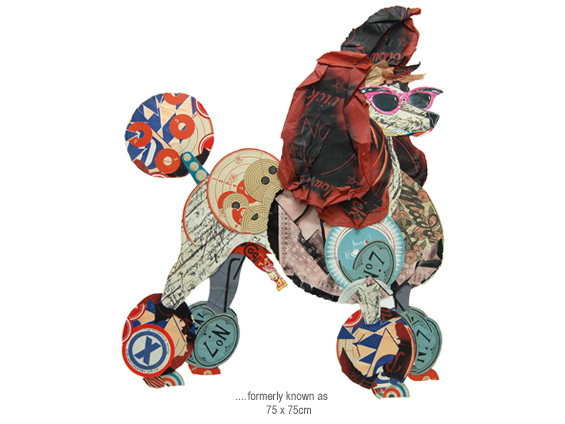
Clark, Peter
From Artist’s website:
“Peter uses a comprehensive collection of found papers as his palette which are coloured, patterned or textured by their printed, written or worn surfaces, with this media he ‘paints’ his collages. He shades with density of print and creates substance and movement with lines plucked from old maps or manuscripts. His pieces use mark-making in an innovative and humorous way to create a collection of beasts and clothing which exude character and wit.”
For more pictures: http://www.peterclarkcollage.com/pages/home.html
de Baar, Desiree

Kitchen / Keuken, knitted wool, pencil on wall, steal construction, 2007 (photo: Art Rotterdam, RAM)
From “Space for Alienation” by Rob Perrée, trans. by Jane Hall:
“Spaces fascinate Desiree de Baar. These can be lived-in rooms in a house or building, but also specific, tough, masculine rooms such as a prison cell or an observation post. She wants to make these spaces her own. She does this by exaggerating some parts, details so ordinary they escape the notice of others, or by displacing the rooms to a gallery or museum where she transforms their character. Thereby she creates alienation. The viewer has to backtrack. His assumptions are thrown to the wind. His faded imagination is stirred. The media Desiree de Baar uses are wallpaper, embroidery and knitting. Media that the viewer might not automatically associate with fine art. On the contrary. She complements them with drawings and sketches.”
For more pictures and information:
Ambe, Noriko

A Piece of Flat Globe Vol. 6, cut on Yupo, glue, 5 1/8 H x 6 11/16 W x 5 15/16 D, 2008 (photo by Masaya Yoshimura)
From Artist Statement:
“It looks like annual rings of a tree or topographical map or wave, but it isn’t. It is absolutely the traces of actions of a person, which is me.”
“When I am drawing or cutting lines, I am interested in observing the power of the changing growing shape.”
“Using the five senses, perceiving the natural qualities of the materials, I found that I am concerned less about the end, and more about “doing”. The process of creating is equally as important as the finished work.”
For further reading: http://www.norikoambe.com/texts/index.html
Stark, Jen
From Artist website:
From “100 Creatives” Miami New Times: “I think geometry, nature, and mathematics have everything in common. My ideas are also based on replication and infinity as well as hypnotic, optical designs that mimic mandalas and sacred objects,’ explains the artist.”
“Stark’s oeuvre of mind-bending work originally began with a summer abroad trip to the south of France where the artist found a friend in construction paper due to its bargain price and potential. Eventually, Stark’s stack of colorful paper transformed into three-dimensional sculptures which has now expanded to include drawings and animation.”
For further reading:
Hals, Gjertrud
From Artist Statement:
“As a seasoned traveller I have observed many different cultures. Much of my artistic work is an attempt at expressing the connection between the islands micro-history and the worlds macro-history.”
“I was educated as a tapestry weaver. However, for about twenty years I have mostly been making free standing sculptures in different fiber, as well as non-fiber materials. I do enjoy the fact that I can creatively act as I please, use whatever material I wish, be severe and meditative one day and playful the next.”
For further reading:
Hyung, Min
From Artist Statements:
Fifth World: “Forgoing the commonplace subject of the world she operates in, Hyung traverses the landscape of her imagination and unleashes extraordinary visual elements, places and characters from her mind’s eye. Similar to the way that J.R.R. Tolkien’s masterpiece novels The Hobbit and Lord of the Rings is comprised of a superfluous information of connected body of tales, poems, fictional histories, maps, several invented languages, and literary essays to tell the story of the imagined world of Middle Earth; Hyung also needs to create the extraneous details of both the characters and the world that they occupy, in order to convincingly bring them visually to life.
“Hyung utilizes paint and technique, as her vernacular of choice in storey-telling, with text as her appendixes.”
“Hyung injects into her paint handling the same intensity, energy and visceral response as she imagines her subjects to possess.”
“The series ‘Looking for My Vocabulary’ is about searching for a personal painterly language by re-interpreting existing visual languages: holiday resort architecture, art historical references and cinematic camera angles. I drop the colour from the source reference, interpret the material in muted tones and line and then, at the last stage of the painting, throw the colour back onto the canvas. I want to create an atmosphere of optical confusion by combining abstraction and illusionistic space. It’s a world of motion, flux, old languages, and new translations.”
For further reading:
http://www.minhyung.com/index.html
Lannin, Katherine L.
From Artist Statement: “My practice stems from a desire to create artworks that collage real space with the space of the metaphor and the allegory. I employ photography, digital and chemical, sculpture and installation as the scaffolding to my research.”
For further reading: http://www.katherinellannin.com/index.html
Dawe, Gabriel

Plexus no4, site specific installation at the Dallas Contemporary + Gutterman thread, wood and nails, 11' x 25' x 25', 2010
From Artist Website:
“In search for creative freedom he started experimenting and creating artwork, which eventually led him to explore textiles and embroidery—activities traditionally associated with women and which were forbidden for a boy growing up in Mexico. Because of this, his work is subversive of notions of masculinity and machismo that are so ingrained in his culture. By working with thread and textiles, Dawe’s work has evolved into creating large-scale installations with thread, creating environments that deal with notions of social constructions and their relation to evolutionary theory and the self-organizing force of nature.”
For further reading: http://www.gabrieldawe.com/
Meade, Alexa

Natura Morta Installation, 8ft x 6ft x 4ft Installation, 2009, Installation comprised of acrylic paint on found objects and the performance of a live model
From Artist Statement:
“Alexa Meade is a 24-year-old artist whose work lies at the intersection of painting, photography, performance, and installation.”
“I paint the surfaces of the human subjects, the material objects, and the architecture of the installations so as to collapse the subject, foreground, and background into one continuous plane.”
“I present my ephemeral portrait/performances as both live, interactive installations as well as permanent photographic indices of these experiences.”
For further reading: http://alexameade.com/cv.html and http://www.flickr.com/photos/alexameade
Stabler, Hunter
Commentary (from Hunter Stabler, Artist Today):
“My work deals with the architecture, patterning and symbols of mythical and theoretical origins.”
“The formal aspects of my work involve a play between the illusion of space, actual physical space, and the two- dimensionality of the paper.”
“Perspectival patterning creates the illusion of form. Flat patterning defines the surface of the picture plane, and a physical cast shadow shows the actual space and thinness of the paper.”
For complete articles on Stabler: http://www.hunterstabler.com/?cat=5
Lee, Bovey
From Artist Statement:
“The underlying themes in my cut paper works are power, sacrifice, and survival.”
“I define what I do as drawing with a knife. My life long love affair with art begins with practicing Chinese calligraphy and pencil drawing since age ten.”
“I hand cut each work on a single sheet of Chinese rice paper. In my recent installations, I have also cut using Tyvek and vinyl.”
“My creative process is three-fold – drawing, digital rendering, and hand cutting. I form ideas by sketching before creating a digital template. The template is a visual guide that consists of downloaded images, my own photographs, scans from magazines and books, and vector graphics. The final step is for me to hand cut the image with an X-Acto knife.”
For Articles on Lee’s work: http://www.boveylee.com/
Pearlman, Mia
From artist statement:
“I make site-specific cut paper installations, ephemeral drawings in both two and three dimensions that blur the line between actual, illusionistic and imagined space.”
“My process is very intuitive, based on spontaneous decisions in the moment. I begin by making loose line drawings in India ink on large rolls of paper. Then I cut out selected areas between the lines to make a new drawing in positive and negative space on the reverse. 30-80 of these cut paper pieces form the final installation, which I create on site by trial and error, a 2-3 day dance with chance and control. Existing only for the length of an exhibition, this weightless world totters on the brink of being and not being, continually in flux. It is my mediation on creation, destruction, and the transient nature of reality.”
For complete links to articles on Mia Pearlman: http://miapearlman.com/press.htm